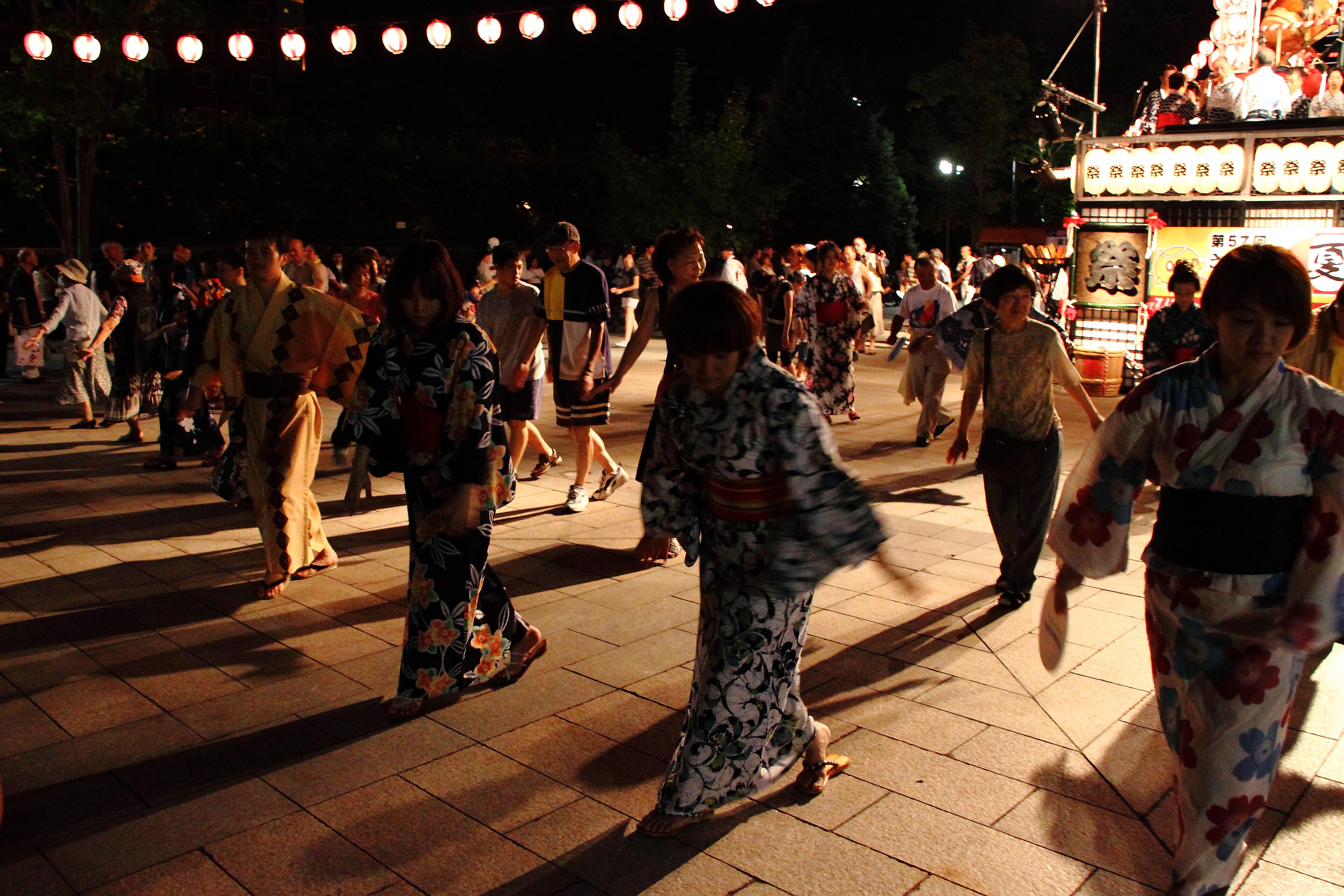
In the northern Kyoto neighbourhood of Matsugasaki, a summer dance begins with a sound that is also a prayer. A drum keeps time. Voices take up the daimoku. The movement belongs to Bon season, but it does not look like a generic festival performance.
Matsugasaki Daimoku Odori is tied to a local story that the Kyoto city government records as beginning in 1306. Tradition says that when the village adopted the Lotus Sutra faith, the priest Jitsugan was so moved that he jumped with joy, beat a drum, and began to chant. The people around him joined in. Whether we approach that account as history, memory, or both, the important point is that the dance remains rooted in a particular neighbourhood and its religious life.
A chant carried in public
The word daimoku can sound abstract when it is encountered on a page. Here it is physical: breath, timing, footwork, and the practical work of gathering people in the same place. Kyoto lists Matsugasaki's Daimoku Odori and Sashi Odori among its registered intangible folk-cultural properties. That designation names a living practice, not an object that can be finished and placed behind glass.
The dance is often described as one of Japan's oldest Bon dances. It is better to hear that description as a local inheritance rather than a competition for age. Its force lies in continuity: people still learn the rhythm, maintain the occasion, and make room for it in the year.
Lotus Village ReadingA prayer can become a form of shared attention. It does not need to leave ordinary life in order to be meaningful.
Watch without turning it into scenery
For a visitor, the most useful first response is simple: notice who the event belongs to. The dance is not staged to prove that Kyoto has an atmosphere. It is a local religious and seasonal practice with its own timing, relationships, and rules.
Dates, viewing arrangements, and photography guidance can change. Check the official Kyoto event information or the host temple before travelling, and follow instructions on the day without treating participants as a backdrop.
Begin with the sound
If you do see the dance, begin by listening before you photograph. The refrain may be the most direct way into the story: a text becomes a chant; a chant becomes rhythm; rhythm becomes a way for a place to remember itself together.